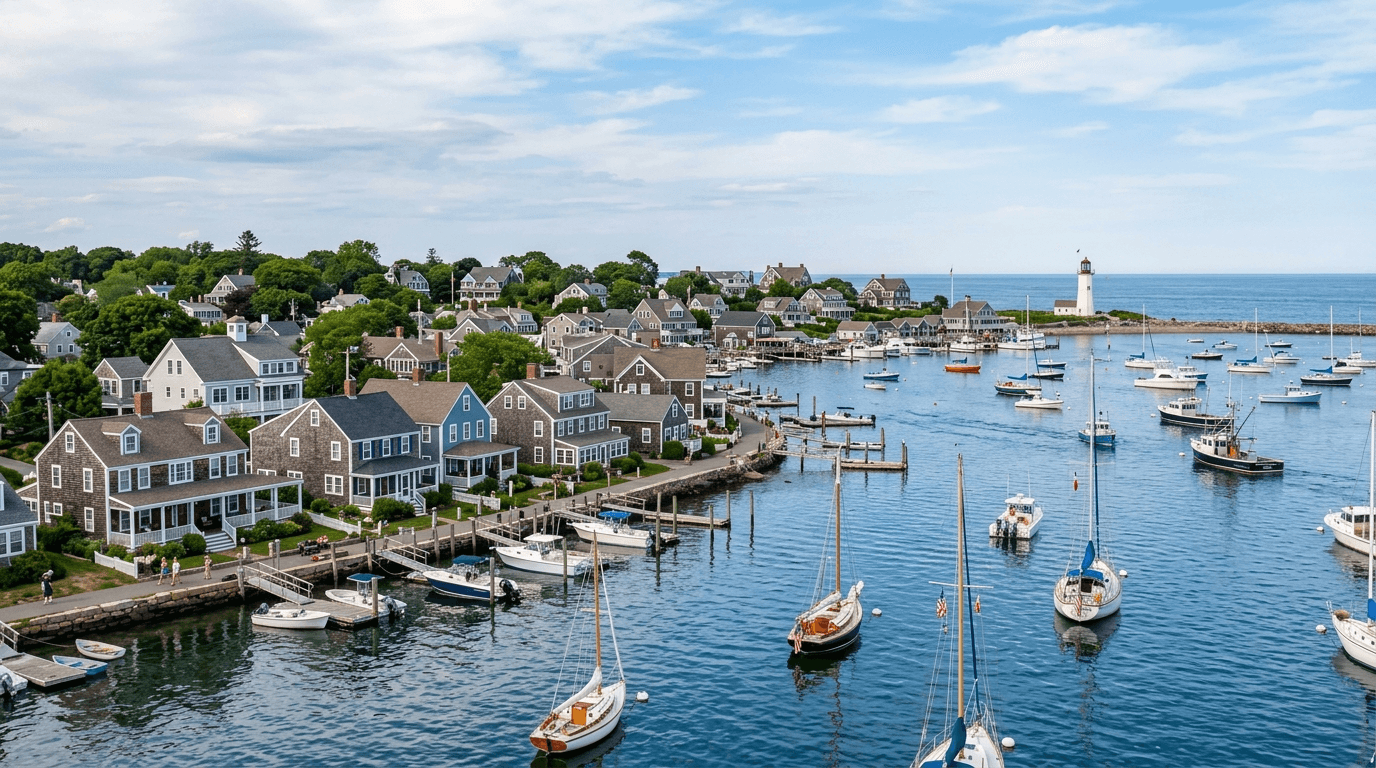
Work with Peter Bouchie, a Belmont, MA real estate agent with 10+ years of residential sales experience across Greater Boston. Serving Belmont, Newton, Scituate, Cambridge, Watertown and Arlington, MA.
Key Takeaways
•The short answer: Two seven-figure Scituate closings reportedly happened in late June 2026. Sales like these don't just fade like a headline. They become the price other homes get measured against — and that can push some buyers toward Hingham and Cohasset.
•The real driver: Scituate's median list price sits near $1,599,000, per Realtor.com/Repliers data. Its listing-side signals still point to a seller's market even as the median listing price has eased over the past year.
•The financing wall: Jumbo loans — those above the conforming limit — cost more each month. That can push some move-up buyers to shop nearby towns.
•The honest caveat: We have no price or supply data for Hingham or Cohasset in this research. The spillover into those towns is a well-reasoned hypothesis — not a measured fact.
Everyone keeps saying the same thing about Scituate this summer.
It's just hot. Prices will cool. Wait a few months and the deals come back.
That logic feels disciplined. Waiting can feel like strategy.
But coastal pricing rarely resets that cleanly.
Two seven-figure homes reportedly closed in Scituate in late June 2026, according to local agent and MLS reports. Those sales don't vanish when the news cycle moves on. They become the comp — the recent nearby transaction that appraisers, sellers, and listing agents use to price the next home.
Two closings don't fade. They reset the floor at the top of the market.
And the bigger question isn't only what happens in Scituate.
It's where priced-out buyers go next.
As of July 6, 2026, those reported June sales are among the freshest pricing anchors in the upper tier of the local market. That matters whether you're buying, selling, or deciding whether Hingham or Cohasset belongs in your search.
Why Can One Big Sale Reset the Top of the Market?
A seven-figure closing shifts what buyers and sellers consider normal at the high end. That's what an anchor price does — it becomes the number everyone starts measuring against.
Be clear about which slice of the market this actually touches, though. Two luxury sales set a reference point for other high-end homes. They don't necessarily reset pricing for the median buyer.
In Scituate, the broader listing-side picture has real support behind it. Homes are selling for about 100% of list price — meaning the final sale price tracks closely with the asking price.
Scituate Listing-Side Market Signals — June 2026
Secondary listing-side indicators for Scituate, excluding days-on-market because a higher-tier MLS source covers that metric.
Supply tells a similar story. There's roughly 4.8 months of single-family inventory — meaning it would take about that long to sell every current single-family listing at today's pace. Under six months is generally considered a seller's market.
Still, the margin deserves honesty. At 4.8 months, Scituate is technically a seller's market, but it sits only a little over a month from the six-month balanced threshold. That's a real seller's tilt — not an ironclad guarantee against softening.
For buyers, that means sellers face limited pressure to discount. For sellers, it means the tilt isn't extreme enough to assume a bidding frenzy.
Realtor.com adds an important wrinkle: the median listing price is down 5.19% from a year ago, even as Scituate carried a seller's market designation in June 2026 with a full-price sale-to-list ratio. That decline matters for the thesis. The upper-tier anchor set by two luxury closings can coexist with a modest year-over-year dip in the typical list price — they describe different segments. The "prices only go up, don't wait" framing overstates the case. The honest read is a firm but not overheated market.
Now look at the pricing gap. Scituate's median list price is $1,599,000. The single-family median sold price over the last 180 days was $993,250. That gap doesn't automatically signal a bubble, but it does tell you something important: the typical home is selling well below the median list price. The seven-figure "floor" applies to the luxury segment, not to the median transaction.
For your wallet, that means the next high-end Scituate listing may be priced off recent luxury sales, while mid-market homes still transact closer to that $993,250 median.
What Is Actually Pushing Buyers Toward Hingham and Cohasset?
The pressure point comes down to monthly payment.
Once a loan exceeds the conforming limit, it becomes a jumbo loan — typically subject to stricter lending standards and a higher interest rate. That threshold sits right where many Scituate buyers are already stretched. Higher jumbo rates plausibly push some move-up buyers toward adjacent communities where the monthly payment becomes more manageable.
So the buyer isn't just asking, "Can I afford the house?"
They're asking:
•Can I afford the mortgage?
•Can I afford the rate?
•Can I afford the taxes, insurance, and upkeep?
•Can I still live the way I want after closing?
That's where Hingham and Cohasset enter the conversation — not because they're automatically cheaper (this research does not include verified price or supply data for those towns), but because a buyer hitting a payment wall logically widens the search nearby.
Two other forces compound that pressure.
First, buyers want turnkey homes. When someone is stretching into seven figures, a major renovation is rarely part of the plan. As agents have noted:
"Buyers want certainty. Turnkey homes consistently draw stronger interest, while fixer-uppers face more resistance."
Second, the South Shore doesn't offer a simple cheap escape. The tradeoffs are more subtle — a different lot, commute, school fit, beach access, harbor feel, or renovation profile. The sticker price changes; the full cost calculation still demands the same rigor.
That's why spillover isn't just about price. It's about lifestyle, payment comfort, and timing.
If Prices Might Cool, Is Waiting the Smarter Move?
This is the fair counterargument, and it deserves a straight answer.
Summer can be competitive. Fall often brings new listings. Buyers sometimes find more choice later in the year. And with the median listing price already down 5.19% year over year, a buyer waiting for modest further softening isn't being irrational. Lower prices — or even flat prices while you save — can reduce your total cost of ownership. The math cuts both ways.
But Scituate's current structure doesn't point to a major break. A market on the verge of falling apart doesn't typically show under five months of supply alongside a full-price sale-to-list ratio. Those are signs of limited inventory, not broad weakness.
There's one important nuance about speed.
Single-family homes moved in a median of just 14 days over the last 180 days. Condos took considerably longer, at a median of 42 days.
Scituate MLS Market Snapshot by Property Type — Last 180 Days
Primary MLS-derived last-180-day Scituate market stats comparing single-family, condo, and mixed property segments across speed, supply, and sold-price levels.
That tells you where the urgency actually lives. Well-positioned single-family homes are still moving quickly. Higher-end and condo listings may sit longer — including some of the very seven-figure coastal homes at the center of this anchor story.
The lesson for buyers is straightforward: don't treat the whole market as one speed. Look at the specific property type you want. If you're after negotiating room, the better move may be a different town, a different property type, or the high-end segment where homes sit longer. The answer isn't simply a different month.
What Are the Strongest Arguments Against the Spillover Theory?
Two objections are worth taking seriously.
Is the Hingham and Cohasset spillover proven by local data?
No — and precision matters here.
The spillover model is borrowed from New Jersey. In markets like South Orange, Maplewood, and Montclair, NYC out-migration was said to push priced-out buyers into neighboring towns. But no data in this research confirms that overflow demand actually raised prices in those New Jersey neighbors. Applying that analogy to Hingham and Cohasset is an untested import, not a validated local finding.
This research also does not include price, inventory, or sales figures for Hingham or Cohasset. The spillover into those towns is a well-reasoned hypothesis built on Scituate's pressure points — not a measured fact.
What we can actually stand on is the Scituate setup: single-family supply near 4.8 months, homes selling at essentially full price, and a median list price of $1,599,000. Add a large Boston-area buyer pool, many of whom face the jumbo-loan threshold and want to stay near the coast, and spillover into nearby towns becomes plausible. But plausible is not proven. The exact size of any spillover isn't measured here.
Does a full-price sale-to-list ratio mean buyers aren't overbidding wildly?
Yes — and the contrast is the whole point.
The New Jersey markets this spillover thesis borrows from reportedly saw homes selling 25% to 33% over ask. Scituate is nothing like that. At roughly 100% of list price, buyers are paying full asking — not stacking wild premiums on top.
The urgency in Scituate is real but far milder than any "frenzy" framing suggests. Near-full-price market is the accurate description. That changes the strategy considerably.
For buyers, the winning move is preparation, not panic:
•Strong financing
•A clean offer
•A clear ceiling
•Fast decision-making
•Discipline around total monthly cost
This isn't about reckless bidding. The list price often already reflects the market, so a disciplined full-ask offer is usually enough — and wild overbids aren't required.
How Should Buyers Compare Scituate, Hingham, and Cohasset?
Start with the lifestyle you're actually trying to buy.
In Scituate, that typically means coastline, beaches, harbor access, village character, and a Boston commute that still works. Water-based recreation was the top amenity named in Scituate's resident survey, cited in 59.0% of responses — a figure drawn from the town's 2018 Open Space and Recreation Plan, reflecting longstanding preferences rather than current-year sentiment.
Most Desired Recreation Amenities in Scituate
Open Space and Recreation Plan survey responses showing the amenities residents most often mentioned.
Open Space and Recreation Plan survey responses showing the amenities residents most often mentioned.
That coastal pull is exactly why spillover is plausible. Many buyers aren't leaving the water. They're trying to stay near it while finding a better fit on price, payment, or inventory.
Here's a practical framework for comparing the towns using the Scituate figures available in this research. The Scituate column reflects placed data; the Hingham and Cohasset columns are a checklist of what to gather — not verified figures we can supply here:
Scituate, Hingham, and Cohasset Spillover Strategy Comparison
Compares recommended summer 2026 buyer strategies and available local market figures for Scituate, Hingham, and Cohasset based on the research cited in the article.
Category
The Play
Key Numbers (this research)
Scituate
Full-ask, move fast on turnkey
List median ~$1.55M; 4.5 mo supply; 99.1% sale-to-list
Don't fall in love with the list price. Study the total cost.
That means looking well beyond the sticker. Compare mortgage payment, interest rate, taxes, insurance, flood or coastal exposure, needed repairs, commute costs, and long-term maintenance. A lower purchase price doesn't always mean a lower cost of ownership. A turnkey home priced higher can sometimes be easier to carry than a "deal" that needs major work. The reverse is equally true — if prices ease and you buy the same home for less later, your total cost drops. Run the math both ways before deciding.
What Should Buyers Do in July 2026?
Pick your lane before you tour. Once you're emotionally attached to a house, the numbers get harder to follow.
Are you trying to buy in Scituate?
Then be ready for the anchor — at least in the upper tier. That doesn't mean overpaying blindly. It means understanding that late-June seven-figure sales may shape high-end seller expectations all summer.
Your best approach:
•Know your payment ceiling
•Get fully underwritten if possible
•Move quickly on strong homes
•Use a clean, confident offer
•Weigh the realistic odds of a discount
For the right Scituate home, a disciplined full-ask offer may outperform waiting. But if you're targeting a home that's been sitting, or the median price eases further, patience can be rational too.
Are you open to Hingham or Cohasset?
Treat those towns as strategic options, not consolation prizes. If Scituate's payment pushes too high, widening the search can protect both your budget and your lifestyle.
But don't assume the neighboring town is automatically cheaper — there's no price data here to confirm it. Run the full cost. Compare the commute. Look at insurance. Study the condition of the home. The goal isn't just to buy something. The goal is to buy well.
Are you hoping for more negotiating power?
Focus on where supply gives you leverage. That may mean a different town, a different property type, or a home that needs work. It may also mean the high-end segment, where homes sit longer and sellers carry less pressure.
Be careful, though. A fixer-upper can look cheaper on paper and still cost more once you add repairs, time, and stress. If your budget is already stretched, certainty has real value.
What Should Scituate Sellers Do Right Now?
July 2026 is a reasonable moment to revisit your number.
The reported late-June seven-figure closings give you fresh comps — recent nearby sales that support stronger pricing conversations at the high end. But precision still matters. The market rewards homes priced correctly and presented well. It doesn't reward wishful thinking.
That warning carries weight: with the median list price down 5.19% year over year, some sellers are asking more than the current market supports. That's exactly why a buyer waiting on an overpriced home can be acting rationally. Both pieces of advice fit together — sellers should price to real comps, and buyers shouldn't overpay simply because a list price is aggressive.
For sellers, the playbook is straightforward:
•Price against the freshest relevant comps
•Prepare the home before launch
•Highlight turnkey condition
•Make coastal and lifestyle features easy to see
•Watch buyer feedback closely in the first two weeks
The first impression carries significant weight. Launch too high and sit, and buyers start wondering what's wrong. Launch with confidence and evidence, and you give buyers a reason to act.
So, Could Two Seven-Figure Scituate Sales Reshape the South Shore?
Yes — but not dramatically, not overnight, and mainly at the top of the market.
They reshape it by shifting the reference point for high-end homes. Sellers use those sales to justify stronger asking prices. Buyers use them to understand what it takes to compete at that tier. Appraisers use them as recent evidence. And some buyers — particularly those running into the jumbo-loan threshold — start looking harder at nearby towns.
That's the real South Shore effect. Not panic. Not collapse.
A pricing anchor in Scituate can push some buyer demand outward, especially when inventory is tight and monthly payments are already stretched. The main takeaway is more measured than the headlines suggest:
Waiting for Scituate to cool dramatically is a bet against limited supply. But with the median list price down 5.19% year over year, modest patience isn't irrational — so weigh your specific home and segment carefully.
If you're buying, the smarter move is comparing total cost across towns and segments. If you're selling, the smarter move is understanding how these new comps affect your pricing window.
Want to see how this plays out for your situation? Ask for a custom Scituate, Hingham, and Cohasset pricing review before your next move.
Common Questions
What do two seven-figure Scituate sales mean for buyers this summer?
Two seven-figure Scituate sales can reset the price anchor for nearby listings. In Scituate MA real estate, fresh June 2026 comps give sellers and appraisers a new number to point to. With about 4.5 months of supply and homes selling near list price, buyers should expect firm pricing.
How does the jumbo loan limit affect Scituate buyers?
The jumbo loan limit affects Scituate buyers by making financing more expensive once a loan rises above the $832,750 conforming limit. The article says that threshold sits near today’s Scituate pricing pressure. When monthly payments jump, some move-up buyers may compare Hingham real estate or Cohasset real estate instead.
Is waiting for Scituate prices to cool a smart strategy?
Waiting for Scituate prices to cool is a risky strategy based on the article’s data. Scituate MA real estate has about 4.5 months of supply and a 99.1% sale-to-list ratio, signs of scarcity rather than collapse. The draft suggests buyers seeking leverage may need a different town, not just a later month.
What should sellers in Scituate do after the June 2026 closings?
Scituate sellers should treat July 2026 as a strong pricing window. The article says the June seven-figure comps are the freshest anchor on record, and homes are selling close to asking price. In Scituate MA real estate, that gives sellers confidence, but pricing still needs to match comparable sales.
How should buyers compare Scituate, Hingham, and Cohasset?
Buyers should compare Scituate, Hingham, and Cohasset by total monthly cost, not only list price. The article warns that taxes, insurance, upkeep, and price per square foot can change which home is truly affordable. It also says Hingham real estate and Cohasset real estate are spillover possibilities, not proven by local data here.
Does the article prove buyers are already spilling into Hingham and Cohasset?
The article does not prove measurable spillover into Hingham or Cohasset. It clearly says there is no verified price, inventory, or sales data for those towns in this research. The case is a logical hypothesis: tight Scituate MA real estate conditions may push priced-out buyers toward nearby coastal options.